 Internet Computer (ICP)
- 67Chỉ số cảm xúc xã hội (SSI)-5.36% (24h)
- #120Xếp hạng nhịp đập thị trường (MPR)-39
- 12Đề cập trên mạng xã hội 24h-14.29% (24h)
- 59%Tỷ lệ tăng KOL 24h8 KOL đang hoạt động
- Tóm tắtICP sees node growth and low fees, but decentralization controversy remains.
- Tín hiệu tăng giá
- Node count up 22%
- Processing rate 198 blocks/s
- Low transaction fee $0.00008
- DFINITY launches advanced DEX
- Highly liked KOL calls it decentralized
- Tín hiệu giảm giá
- Centralization security controversy
- Only nodes 4-26 can be attacked
- Social hype down 5%
- Low AI Crypto hype
- Questioning the credibility of node counts
Chỉ số cảm xúc xã hội (SSI)
- Tổng quan dữ liệu67SSI
- Xu hướng SSI (7 ngày)Giá (7 ngày)Phân bổ cảm xúcCực kỳ lạc quan (17%)Tăng giá (42%)Trung tính (8%)Giảm giá (17%)Cực kỳ bi quan (16%)Thông tin chuyên sâu SSIICP social hype is moderate (66.9/100, -5.4%), activity dropped sharply by 20% causing overall decline, positive sentiment rose 8.6% and KOL attention is top score, corresponding to positive signals such as node growth and low fees.
Xếp hạng nhịp đập thị trường (MPR)
- Thông tin chuyên sâu về cảnh báoICP warning rank rose to #120 (↓39), social anomaly dropped to 50/100 (-48.4%) but sentiment polarization surged to 3.99/100 (+210%), indicating a risk of sentiment polarization, linked to decentralization controversy.
Bài đăng trên X
 BeInCrypto Media Educator D86.90K @beincrypto
The Era of Near-Zero Blockchain Fees? 🌐 According to @chainspect_app, @dfinity recently recorded its lowest average transaction fee of the week at a mere $0.000081. To put that into perspective, you could distribute funds to an entire stadium of users for the price of a cheap dinner.
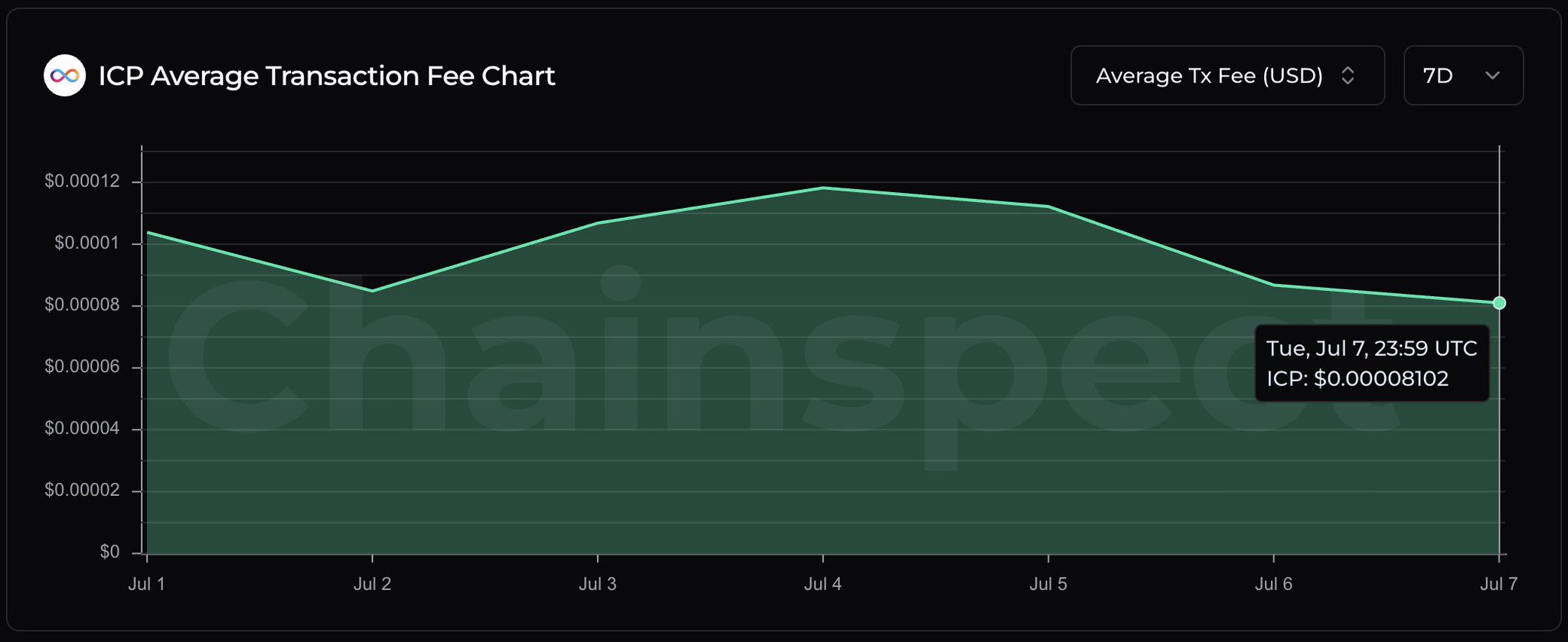 45 1 2.66K Gốc >Xu hướng của ICP sau khi phát hànhCực kỳ lạc quanICP average transaction fee hits a new weekly low at just $0.000081, showcasing an ultra‑low fee advantage.
 BSCN Media C1.36M @BSCNews
Fees? https://t.co/k7knSCYizm
 Internet Computer Today D27.75K @DfinityToday
$ICP fees are basically invisible 🔥 This is what true scalability and sovereignty look like — near-zero cost on-chain activity on the frontier cloud.
52 3 11.48K Gốc >Xu hướng của ICP sau khi phát hànhTăng giáICP chain fees are almost zero, demonstrating high scalability. Fabio Regulatory_Expert Security_Expert S5.65K @Zero2HeroZombie
The number of $ICP Node Machines in Subnets is now 22.3% up since the 4th of June📈 (from 677 to 828) https://t.co/2WrIg5IXgL
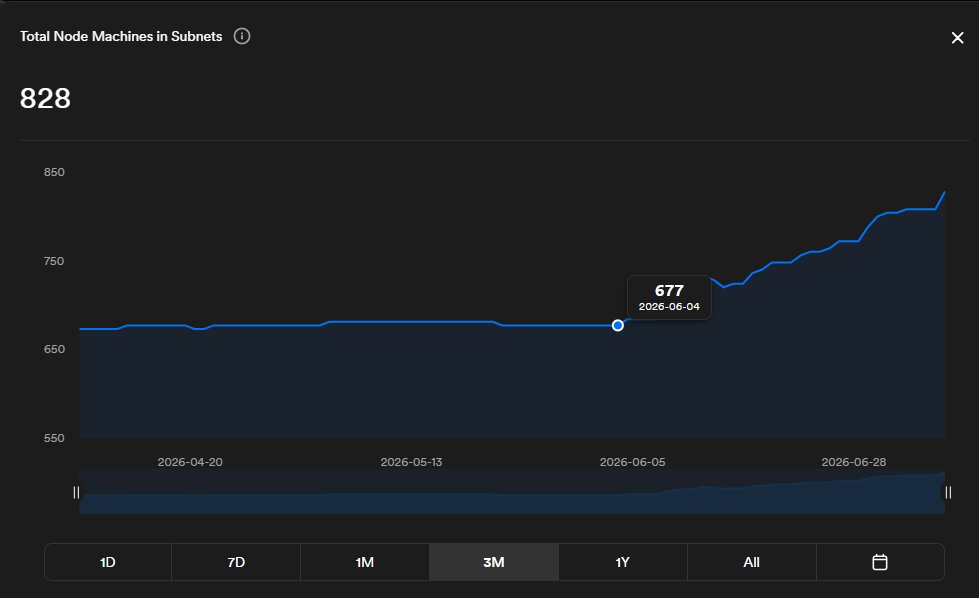 114 3 1.99K Gốc >Xu hướng của ICP sau khi phát hànhTăng giáICP node machine count has risen 22.3% since June 4, reaching 828.
 Cloud Foundation ☁️ D6.13K @BobbyO_
🔴 Just fyi this is NOT me They just put an extra _ at the end $ICP $CLOUD ☁️♾️ https://t.co/BZZ2cS8EtO
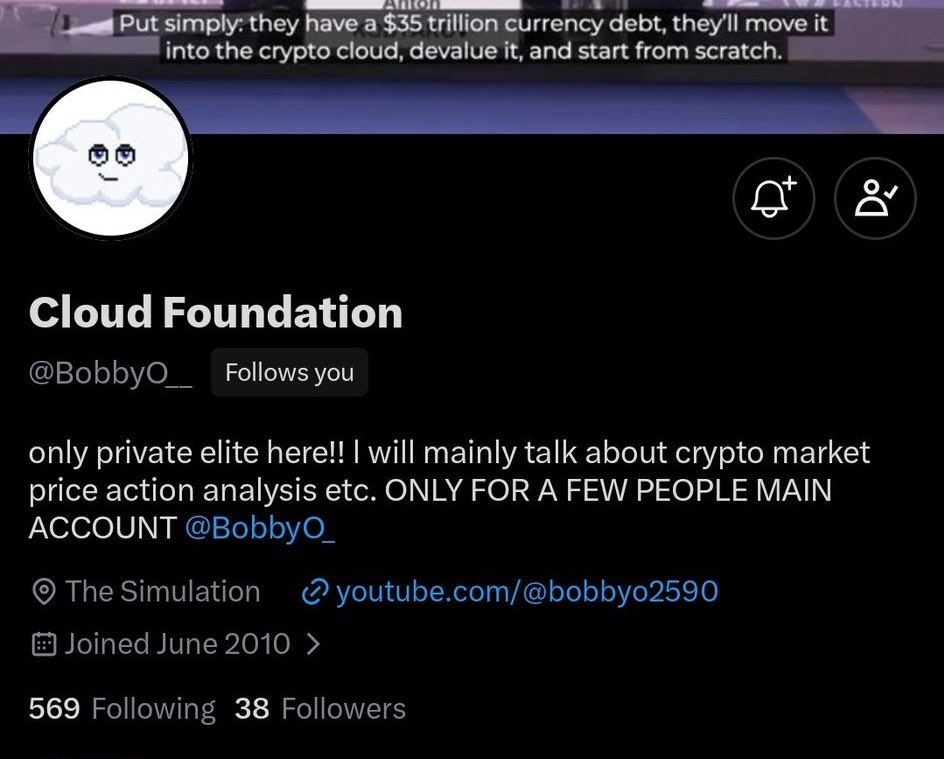 104 10 1.72K Gốc >Xu hướng của ICP sau khi phát hànhCực kỳ bi quanThe tweet author clarifies identity, and the image predicts the global economy will reset due to massive debt, leading to currency devaluation and a shift toward crypto cloud.
- Fabio Regulatory_Expert Security_Expert S5.65K @Zero2HeroZombie
Tomorrow⬇️🇨🇭 https://t.co/E65FXfLGXW $ICP = World Computer
39 0 1.29K Gốc >Xu hướng của ICP sau khi phát hànhGiảm giáICP may drop tomorrow - Fabio Regulatory_Expert Security_Expert S5.65K @Zero2HeroZombie
The $ICP Blockchain is now processing 198 Blocks/s⚡️ https://t.co/SssgEb7mXe
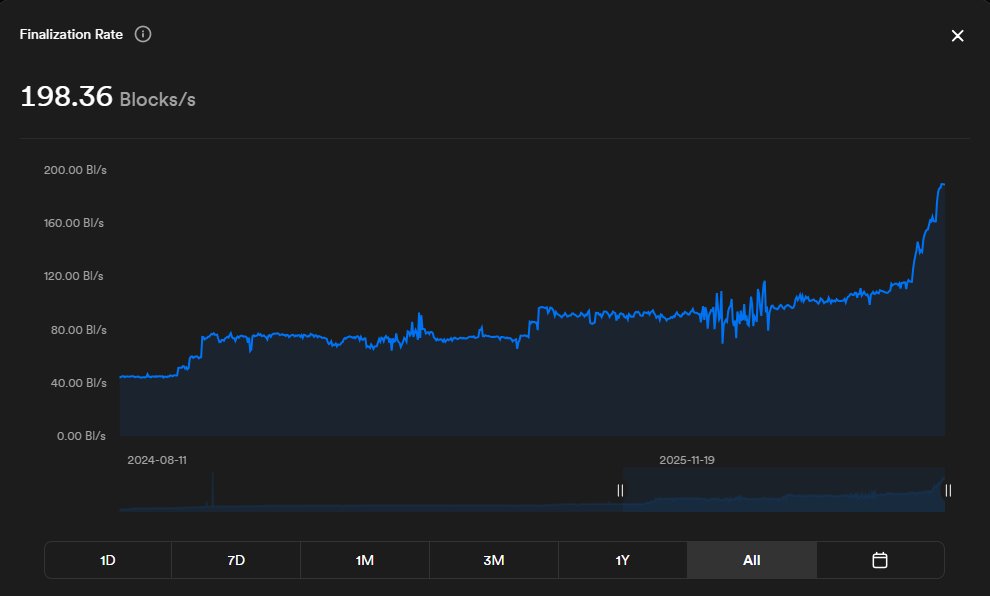 140 2 2.63K Gốc >Xu hướng của ICP sau khi phát hànhTăng giáThe ICP blockchain's block processing speed reaches 198 Blocks/s, with a significant performance boost.
  Justin Bons Founder FA_Analyst B66.03K @Justin_Bons
ICP is centralized & insecure! Any subnet can be taken down by attacking 4-26 nodes! @dominic_w correctly points out that there is more to decentralization than node counts However, a chain is only as strong as its weakest link! That is the "Nakamoto Coefficient" approach: 🧵 1. The bottom line is that the decentralization of the system cannot be higher than the node count At least not from the perspective of the Nakamoto Coefficient, as the node count then becomes the lowest possible bar Your general critique regarding other chains is fair, for example, looking at SOL, its Nakamoto Coefficient is mostly measured as being 19 However, when accounting for stake distribution, the actual number is 12. However, it can never exceed the node count! Or in SOL's case, higher than the stake distribution, because the Nakamoto Coefficient always looks at the lowest possible denominator That is where my critique against ICP holds water, as it is highly centralized from this perspective. At a similar level to SOL, as a matter of fact. As I am also an advocate for increasing node counts on SOL. I am personally less concerned about stake distributions as they tend to decentralize organically over time We should be in agreement on this, since as far as I understand, ICP is actually in favor of developing randomized node shuffling, which would absolutely solve this problem in a similar vein to how sharding does as well 2. This is where we might disagree, as a crypto researcher, it is absolutely possible to find out the "real" numbers That is exactly what I do professionally. When people attempt to hide things, it tends to leave a big, very noticeable hole. Should it be more accessible to the public? Absolutely, it should! However, that does not mean some projects can be fully transparent today Which is currently not the case for ICP, as we are still waiting for disclosure of the insider addresses from either Dfinity or Arkham Research! That information is still not available to the public today! Despite it being requested by major parties over the years, myself included. A perfect example of the type of bad practices you were talking about That is an example of a red flag that might be a good reason to keep people away from this project. My critique this time was more focused on the technical aspects, though In the case of SOL, for example, these numbers are at least transparent & knowable, with no giant holes in the chain analysis like there are in ICP Furthermore, from this argument's perspective, criticizing another chain also has no bearing on my ICP critique. As ICP & SOL should both improve their decentralization! 3. To clarify my position some more, I would define decentralization as a measurement of the "distribution of power" We can agree on this point, as your definition is compatible with mine: "what matters is the number of independent parties involved in consensus" 4. This is where we radically depart in terms of crypto philosophy & also where you massively depart from what is generally considered to be the basic assumptions most make in blockchain design That does make ICP very novel, so I will give you that I fundamentally disagree, the anonymity (permissionlessness) of the system is a key attribute that contributes to the system's security & censorship resistance A great example of that was the recent OFAC & Tornado Cash sanctions Most validators complied, as they had to within their legal jurisdiction. However, only because there were a few anonymous validators, those TX's were able to route around the censors That is a practical example that highlights why this is a critical aspect of a blockchain's design I would argue that if an ICP subnet is targeted by such regulations, it is far more likely that it will comply, which, from my perspective, would be a bad thing 5. This is another example of where you radically depart from what is considered general crypto knowledge Again, that is not a valid argument for why you are wrong, but it is worth noting that, in a crypto context, this is a radical argument. Ofcourse from a traditional perspective, yours is a normal position to take Your response to my critique is that you are disconnecting the "cost of attack" of stake from the security model, which is, first of all, to agree & bite the bullet. Appreciate that! While arguing, you replaced it with legal & reputational guarantees However, that is exactly what fundamentally goes against the crypto ethos The whole point of crypto is that we rely on crypto economic game theory, not reputation, legal & authoritarian systems You have basically turned crypto philosophy upside down on its head. It goes against everything we stand for in crypto on the deepest and most fundamental possible level 6. We clearly must have a different definition of shared security, if a subnet can be taken down by attacking those specific nodes, then security is not shared across all subnets... Even if some of the verification takes place on the NNS Again, this can be solved by doing randomized node shuffling! Something I know ICP is working on! 7. Will again agree with you on the importance of having independent node operators While completely disagreeing with you that this is not possible on a traditional PoS network. It is the opposite, only on a truly permissionless system at scale can we reach higher levels of decentralization Effectively placing power in 4-26 operators is always going to be weaker compared to a system with thousands of independent operators ICP limits the number of operators per subnet. What I am advocating for, "node shuffling," means that each subnet would have the security of all nodes! So, in my analysis, it would go from 7-40 nodes to 800+ nodes. With a Nakamoto Coefficient closer to 500! (ignoring stake distribution) Would that not be far better from a decentralization perspective? The great thing about this style of sharding is that it would not lead to any loss in performance either! The random shuffling just means an attacker cannot target a specific set of nodes; they must target all nodes instead. Clearly, that would be a much harder attack to pull off 8. Can also agree with you that ETH is not making the right trade-offs in terms of that balancing act However, ICP takes sacrificing decentralization in the name of efficiency too far. I do not think it is safe; it is dangerous The trade-off also makes very little sense to me from a design perspective in 2026. As ICP is extremely centralized, yet it still lacks capacity due to how the subnet fragments the usage, breaking up otherwise composable DeFi This is,ofcourse, the old monolithic vs. modular argument all over again. A debate I have been having since day 1 Conclusion: The ICP community often claims to be far ahead technologically. From my perspective, that is not the case at all If anything, ICP is far behind; this is also reflected in the lack of adoption compared to chains like SOL & HYPE I can respect the novel philosophy; however, the market clear still values decentralization in the traditional sense. Despite all of the shortcomings, you might correctly point out There are real technological shortcomings, along with serious concerns around the safety of this system, especially if it ever gained serious traction There are multiple solutions that could absolutely solve the critiques I made here My motivation for writing this is to set the record straight. Bad design does not bother me, misrepresenting & misleading people around a bad design is where I take issue & spring into action ICP has a bad design, as it is highly centralized & insecure compared to traditional PoS chains. While we get very little in return in terms of capabilities for that trade-off However, it would take relatively small changes to make ICP great. That is why I have advocated for ICP to adopt a sharded design closer to what NEAR has. As most of the primitives are already in place to make that happen, it is not a giant leap to go from subnets in a modular design to shards in a monolithic design Will also praise ICP's governance, as I also did in my original critique, as that might provide the path towards solving these problems Hope you can all appreciate the role an outside critic can serve for a small cryptocurrency like ICP. The level of toxicity I receive is proportional to the likelihood of positive change from my perspective So, do not close your minds to change, embrace criticism & do so civilly! Thank you, Dom, for taking the time to counter my arguments. We might still strongly disagree with each other, but I hope the net result of the discussion can still be a positive influence for ICP as a whole ❤️ As always, I wish the ICP community the best! As I want you to succeed, at the end of the day, we should not care what three-letter acronym pulls us across the finish line! 🔥 https://t.co/s2PtCt0G3i
 dom | icp D220.56K @dominic_w
ICP uses a highly sophisticated security and decentralization model, which all blockchains that wish to function as clouds will need to copy. Justin's latest misunderstandings (below) provide a good segue to talk about this, and share some expertise that even networks he's invested in might use. 1. Node count does not equal security or independence from centralized actors. The claim that the number of nodes in a proof-of-stake network reflects decentralization and security is only an attractive idea that boils down to industry folklore and marketing. The node count doesn't matter per se, as I explain below. For networks that depend on consensus to function, their security actually derives from the total number of *independent participants* involved consensus, and how voting power/participation power is divided between them. In proof-of-stake networks, voting power derives from stake, rather than nodes. However, large stakers often stake via lots of nodes, sometimes to create the impression of decentrali
27 40 8.17K Gốc >Xu hướng của ICP sau khi phát hànhGiảm giáICP lacks decentralization and is insecure, requiring more nodes and random allocation ∞ ICPReptillian ∞ Influencer Community_Lead A2.08K @CambrinNolan
 The ICP Apprentice D651 @ICPapprentice
$ICP Signal ♾🚨 DFINITY just dropped MULTI/DEX, a decentralized exchange it calls the most advanced DeFi in crypto. Everyone's arguing the features. The line they skimmed: it will be handed to the NNS for ownerless, autonomous execution. An exchange with no owner isn't a better exchange. It's a different category. Every exchange that ever hurt people came down to one thing. Someone else held the money, and one day said no. Even the best on-chain DEXs, Hyperliquid included, still leave one piece on a company's servers. This is trying for none. But ownerless is the plan, not the fact yet. So I'm taking 4 questions straight to the team. See the signal♾🚨
161 9 3.43K Gốc >Xu hướng của ICP sau khi phát hànhTăng giáICP launches ownerless multi‑chain DEX, outlook positive. ChrisYost.icp ∞ Educator Influencer A1.87K @ChrisYost_
Dom absolutely took @Justin_Bons to school on $ICP Justin "ICP is insecure and centralized." Dom: — node count is marketing folklore — anonymous stakers fake decentralization — one entity secretly runs the majority of nodes on chains Justin is invested in — Hetzner deleted 40% of Solana overnight — ICP Nakamoto coefficient: 17+ — deterministic decentralization: unique to ICP — "even networks Justin holds dear will copy this" class dismissed. $ICP $CLOUD | @dfinity @dominic_w
 dom | icp D220.56K @dominic_w
ICP uses a highly sophisticated security and decentralization model, which all blockchains that wish to function as clouds will need to copy. Justin's latest misunderstandings (below) provide a good segue to talk about this, and share some expertise that even networks he's invested in might use. 1. Node count does not equal security or independence from centralized actors. The claim that the number of nodes in a proof-of-stake network reflects decentralization and security is only an attractive idea that boils down to industry folklore and marketing. The node count doesn't matter per se, as I explain below. For networks that depend on consensus to function, their security actually derives from the total number of *independent participants* involved consensus, and how voting power/participation power is divided between them. In proof-of-stake networks, voting power derives from stake, rather than nodes. However, large stakers often stake via lots of nodes, sometimes to create the impression of decentrali
104 6 2.09K Gốc >Xu hướng của ICP sau khi phát hànhCực kỳ lạc quanThe tweet emphasizes ICP's unique decentralization model as superior to other chains and predicts other blockchains will follow suit.- Cloud Foundation ☁️ D6.13K @BobbyO_Cloud Foundation ☁️ D6.13K @BobbyO_
@d3h3d_ I’ll extend the same debate offer to you ICP vs any L1 you want. Needs to be long form. Minimal 2hrs. Sometime in the next 2-3 weeks.
57 3 3.21K Gốc >Xu hướng của ICP sau khi phát hànhTrung tínhInvitation for a long‑form debate on ICP versus any L1


